
Clinical Atlas of Antibiotic Therapy
From classification to clinical traps - what to give, why, for how long, and what comes back to you afterwards.
102 pages in five chapters: the principles, a full classification of the drug families, prescribing routed by site of infection, adverse effects and toxicity, and a whole chapter of clinical traps. Every agent with its Israeli trade name, generic name and a typical adult dose; every regimen with a duration; and every unit with its own glossary in Hebrew, transliteration, English, Russian and Arabic.
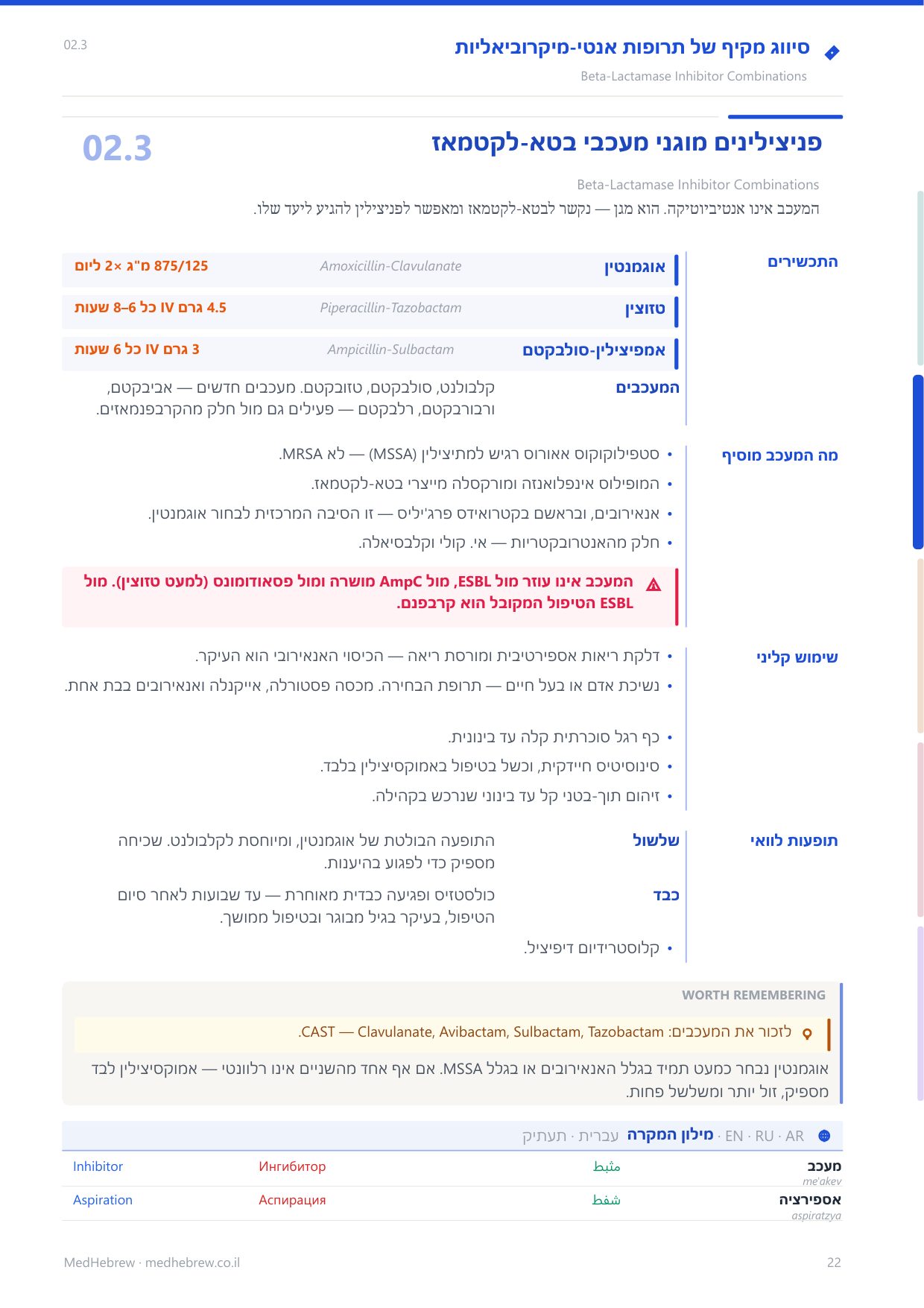
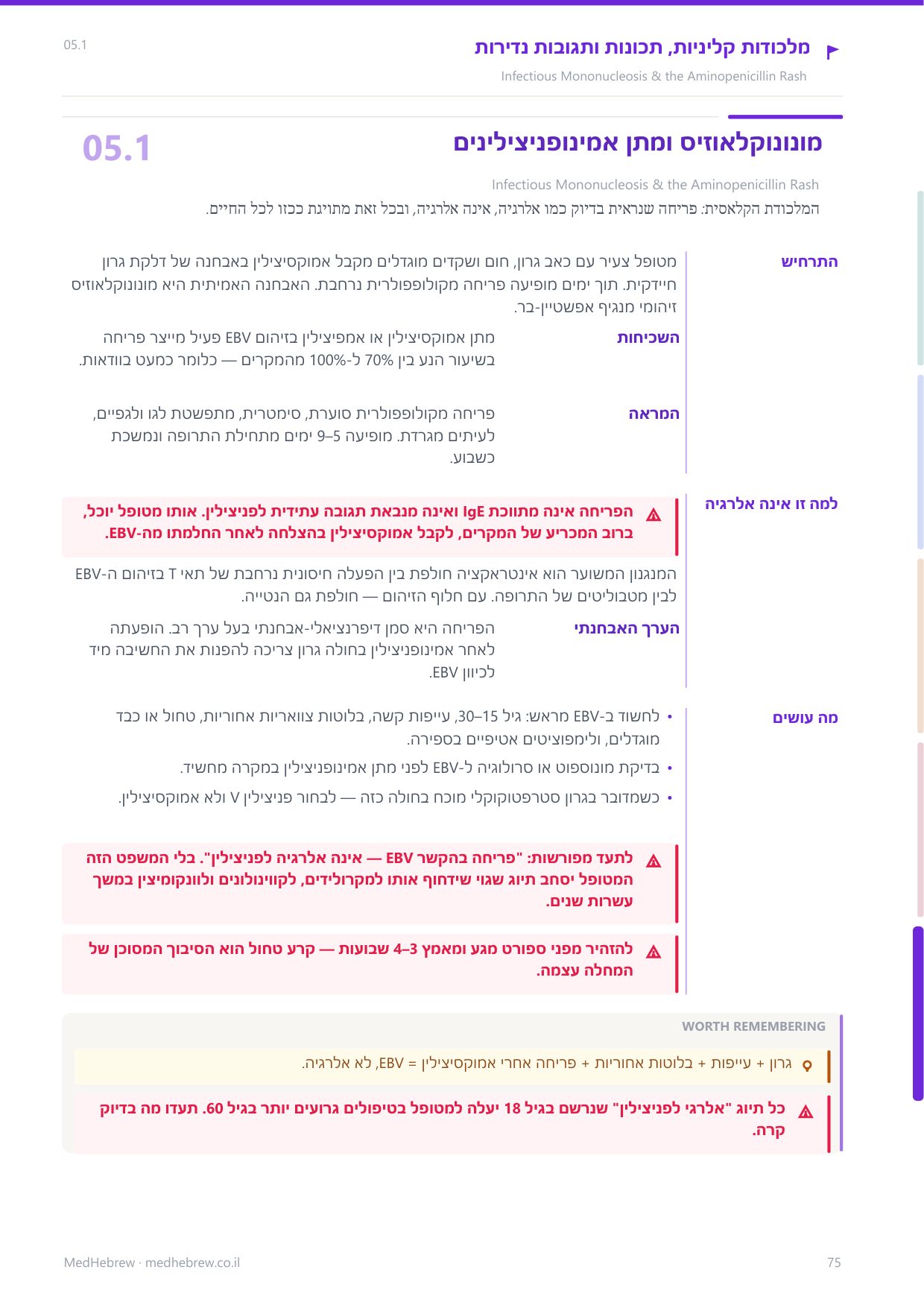
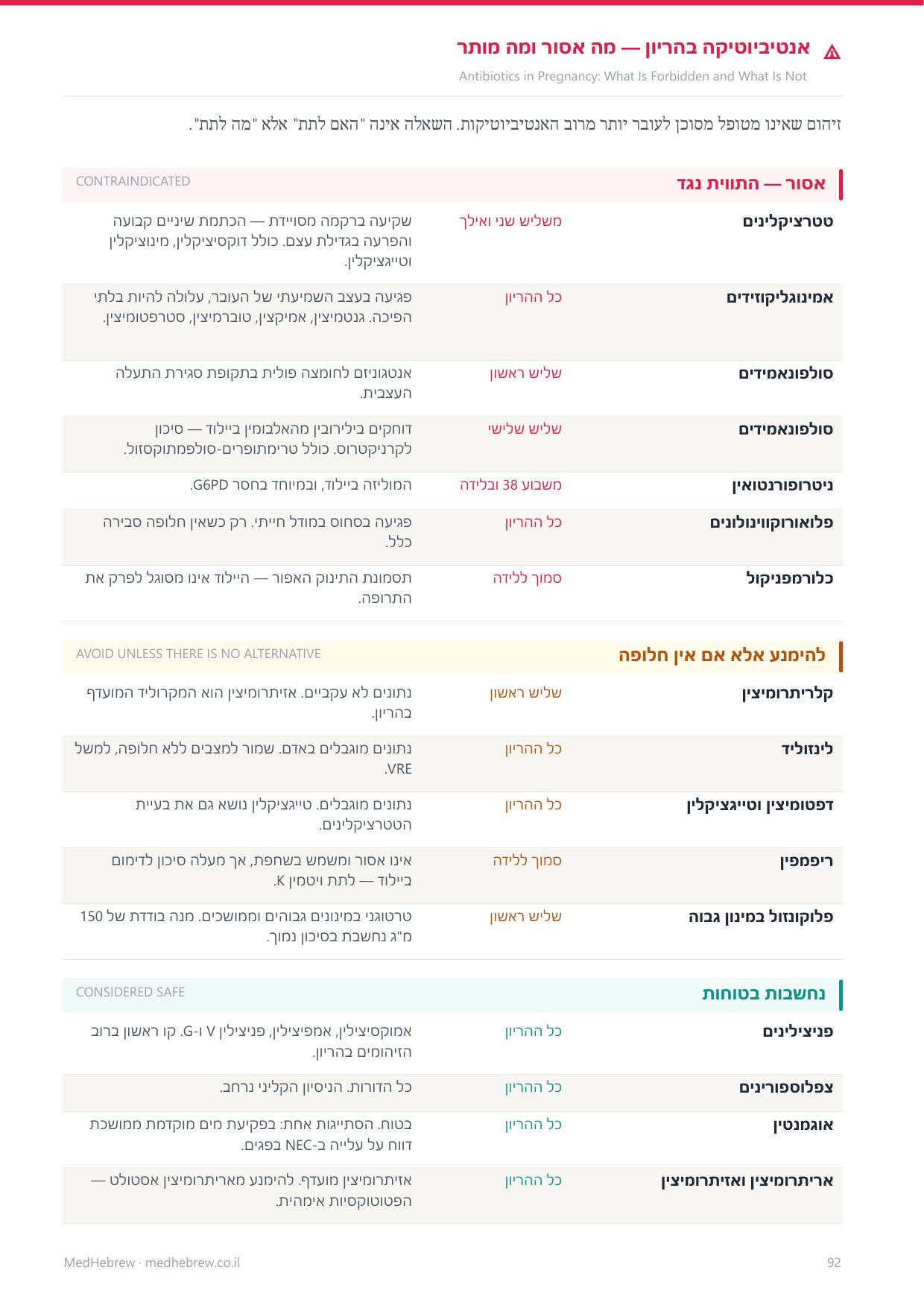
Sample pages: a drug monograph, a clinical trap, and the pregnancy card
Every regimen has a duration
A dose without a number of days is not a prescription, it is a hint. Every regimen here ends with when to stop - including the short courses that became standard in the last decade.
A whole chapter of traps
The aminopenicillin rash in EBV, red man syndrome, fluoroquinolone tendon rupture, doxycycline photosensitivity and the mislabelled penicillin allergy - written as decisions, not as phenomena.
A pregnancy card to flip to
Three tiers - contraindicated, avoid, considered safe - each row giving the trimester and the reason. Built to be looked up with a patient in front of you.
One-time purchase. After payment we’ll email you a personal PDF - searchable, bookmarked by chapter, readable offline and printable - plus an access code for online reading in your account, on any device.
By Team MedHebrew · about us →Who is this for?
Senior medical students, residents, family, paediatric and emergency physicians, pharmacists and clinical pharmacologists. Anyone who writes an antibiotic prescription - or gets asked about one.
Can I download the file?
Yes. You get a personal PDF by email - searchable, bookmarked by chapter, readable offline and printable. Your name and email are printed on every page so the copy stays yours. You can also read it online in your account.
Is this a treatment protocol?
No, explicitly. The book opens on a page that says so: doses are typical adult doses for normal renal and hepatic function, resistance patterns differ between hospitals, and where this book and your institutional guideline disagree, the guideline wins.
When does the code arrive?
Once payment is confirmed - usually within a few hours, and no later than 24 hours. The code and the file are sent together to the same address.
Do I need an account?
For online reading, yes - a free account with any email address. The PDF reaches you by email either way.
I have a question or a problem
Email us at medhebrew@gmail.com or reach us through the MedHebrew Telegram channel - we’ll be glad to help.
This book is study material and a professional reminder. It does not replace clinical judgement, the manufacturer’s leaflet, or the guidelines of the institution you work in.
More from MedHebrew
Every book comes as a personal PDF and opens in your account.
Orthopaedics and Musculoskeletal Medicine
When to image and when not to, how to examine, and what you cannot afford to miss.
One-time purchaseDigestive System Surgery
Licensing-exam preparation - oesophagus to spleen, with the classifications and the traps.
One-time purchaseAnatomy Atlas
An illustrated anatomy atlas of the human body.
One-time purchasePsychiatry Guide
A practical psychiatry guide in medical Hebrew.
One-time purchaseCommon Diseases Handbook
The unit doctor’s pocket book - routine, emergency and field medicine.
One-time purchase